

How can solo developers reliably find premium consulting clients?
Reliably finding clients as a solo developer consultant starts with understanding that the market still needs you, but not for a general set of technical skills. The key is having a clear, premium consulting offer and choosing one or two client-finding strategies that fit your personality, timeline, and risk tolerance.
Does reliably finding clients strike fear into your heart whenever you think about going solo as a consultant? I get it.
The news is hammering us with drama. “AI is taking all our work!” Or “20,000 people were just laid off at a FAANG!”. And then you’ve got YouTubers preying on your insecurities by shouting “software is dead!”
But the truth is, companies have more technology problems than ever.
So here’s the good news: if you’ve got a good offer, it’s never been easier to find consulting clients. And you’ve got some great options for finding them—as long as you know which one is going to work best for you.
In this article, I’m going to walk you through five ways to find clients who’ll pay premium prices for what you offer. And by the time you’re done reading, you’ll know which one is probably the right starting point for you.
In my Technical Guide Offer Workshop, I help you build that premium offer first. So all of these client-finding methods have something solid to point to, instead of just hoping somebody wants “some coding help.”
What key factors should I weigh before choosing a client-finding strategy?
Before you decide how to go get clients, you need to understand four big tradeoffs. Every way of finding clients scores a little differently here, and when you see that clearly, it becomes much easier to choose the approach that fits your life right now instead of randomly trying everything.
What gets people in trouble when they try to find clients is not thinking about the big picture. They hear “start a YouTube channel” or “do cold outreach” or “you’ve just gotta network more,” and they jump in without realizing what they’re signing up for.
Here are the four aspects of finding clients that’ll really help you decide which approach makes sense:
How much trust does this method start with?
Ever get an email from someone you’ve never met asking you to buy something?
You probably marked it as spam or trashed it without thinking. That’s because they were asking for a sale without building any trust with you first.
It’s a lot easier to do business with someone who already knows you. Someone who’s seen your work, watched your content, or worked with you before—than a total stranger. Every method for finding clients either starts with low trust (like a cold DM) or high trust (like a warm introduction), and that starting point massively changes how many conversations you need to have.
When I’m guiding developers in the Technical Guide Offer Workshop, we’re always thinking about how to frame your offer so it earns trust faster. Even if you’re starting from cold.
How fast can this actually lead to a client?
Speed is the second aspect.
YouTube, for example, can be a great way to find clients. Even a tiny channel with five to ten of the right videos can bring in more business than you can handle!
The problem is, it can take a while for the algorithm to even notice you exist. Platforms like YouTube or LinkedIn don’t automatically reward you just because you made something helpful. They have to “learn” who your content is for.
On the other hand, something like cold outreach can get you responses this week—because you’re going straight to people instead of waiting for them to find you.
In the workshop, I’m very aware that most folks can’t wait twelve to eighteen months for inbound to kick in, so we design offers that can work with both fast and slow channels.
How hard is it to execute well?
The third aspect is difficulty.
You’ve probably heard that speaking engagements are a great way to meet potential clients. And that can be true—spending time in person is one of the fastest ways to build trust and sell your consulting offer.
But it can take a lot of practice to deliver truly impressive presentations. The kind of talk that makes people line up afterward and say, “Hey, can we talk about working together?”
Some methods are mechanically easy but emotionally hard. Some are logistically demanding but feel natural once you’re there. You want to pick a path that stretches you, but doesn’t require you to become a completely different person overnight.
A big reason I built the Technical Guide Offer Workshop was to break this difficulty down: instead of “be good at sales and marketing,” we focus on having one clear offer that’s much easier to talk about, regardless of which method you pick.
How scalable is this over time?
The fourth aspect is scalability.
Tapping into your personal network may be the fastest way to find your first client. But your connections are a finite resource. Unless you’re a serious socialite, you can run out of long-term prospects pretty quickly if your only strategy is “ask people I know.”
On the other hand, publishing content online is nearly infinitely scalable—but slower to start.
Now that you know the four tradeoffs that influence each method, let’s walk through the five main ways to find clients and how each of them lines up on trust, speed, difficulty, and scalability. As you read, you can mentally match them to where you are right now in your career—and to the kind of offer we’d build together in the workshop.
What is cold outreach and how can I use it to find consulting clients?
Cold outreach is when you contact someone who doesn’t know you yet and start a conversation that can eventually lead to a consulting engagement. It’s one of the fastest ways to get in front of potential clients, but it starts at almost zero trust, so your message and your offer have to be sharp.
“Cold” just means you’re contacting a client who doesn’t know you already. “Outreach” just means you’re the one initiating the contact, not waiting for them to discover you.
You’ve probably experienced this yourself—maybe even sometime today.
Ever get a DM on LinkedIn from someone offering to help you?
If you didn’t have the problem they were talking about, you probably felt irritated that they messaged you. But if you did have that problem, that person may have just successfully found a client using cold outreach.
How does cold outreach rank on the four aspects?
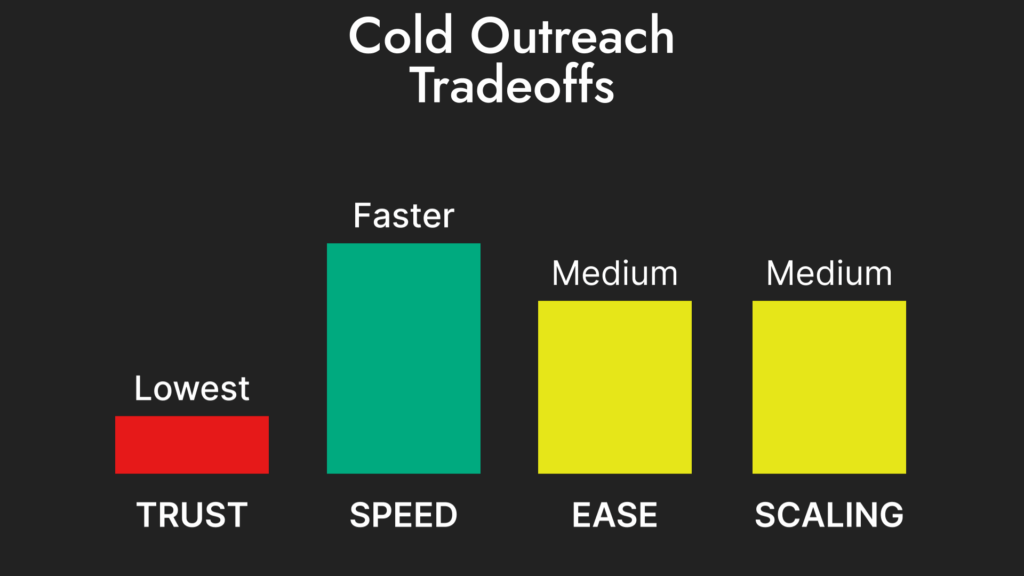
Here’s how cold outreach stacks up:
- Trust: It has the lowest baseline trust. You’re basically cold emailing or DMing someone who’s never heard of you before.
- Speed: It’s the second fastest way to obtain clients, because you don’t have to do much upfront work. Once your messaging is ready, you can reach out today.
- Difficulty: It’s about middle of the road. You’ll need to learn where to find the right people and what to say so you don’t sound spammy or generic.
- Scalability: It’s reasonably scalable. Getting more clients mostly means contacting more people or refining your targeting.
Cold outreach rewards consistency and clarity. Willing to hear “no” or be ignored a lot? Got a focused, business-outcome-driven offer? It can work surprisingly well.
Inside the Technical Guide Offer Workshop, we build offers that are specific enough that a cold message like “I help companies reduce failed deployments by 60% in 90 days” makes sense to the right person, instead of sounding like vague noise.
How do I use my existing network to land my first consulting client?
Networking means reaching out to people who already know you and seeing whether they (or someone they know) have the problem your consulting offer solves. It’s usually the easiest and fastest way to land your first premium client, but it doesn’t scale forever.
The person you network with could be someone you worked with in the past or someone you know through some other relationship—meetups, church, past side projects, you name it.
Own your tech career by crafting a technical guide offer in 4 evenings that’s worth $300+/hr
How does networking compare?
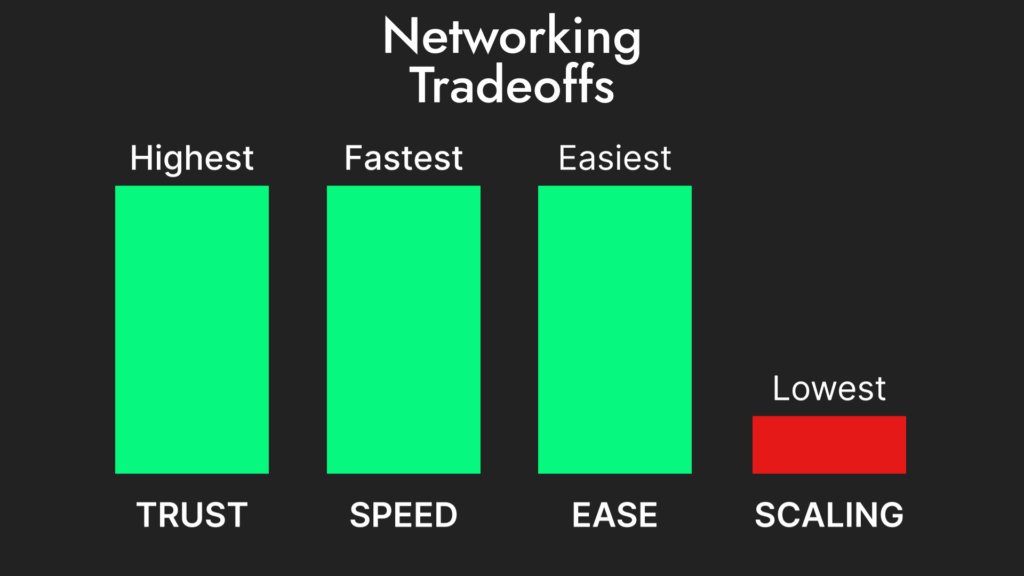
Let’s see how networking stacks up:
- Trust: It has the highest trust, because you’re contacting someone who already knows you. They’ve seen your work or your character up close.
- Speed: The speed of acquisition, at least for your first client, can be very fast—assuming you know someone who has the problem your offer solves.
- Difficulty: It’s the easiest way to land a client. In a lot of cases, all you need to do is reach out, have a real conversation, and make your offer where it fits.
- Scalability: It’s the worst method for long-term scaling. You can only find a new client if they’re already in your orbit or someone refers them to you.
If you’ve got a solid network, I usually recommend you use it. Even just sending a few “Hey, here’s what I’m doing now—do you know anyone dealing with X?” messages can surface opportunities quickly.
In the Technical Guide Offer Workshop, we spend time reframing your experience into business value so that when you do tap your network, you’re not saying “I do some coding on the side”—you’re describing a clear, premium offer people can repeat to others.
How does content marketing help solo developers get consulting clients?
Content marketing is when you create helpful content (videos, articles, posts, podcasts etc.) that speaks directly to the problems your ideal clients are struggling with, and over time they begin to see you as the natural person to hire.
That’s exactly what I’m doing in this article (and the accompanying YouTube video). I’m creating content to help my prospective clients, and eventually, some of them consider working with me because they’ve already seen how I think and how I explain things.
How does content marketing rank?
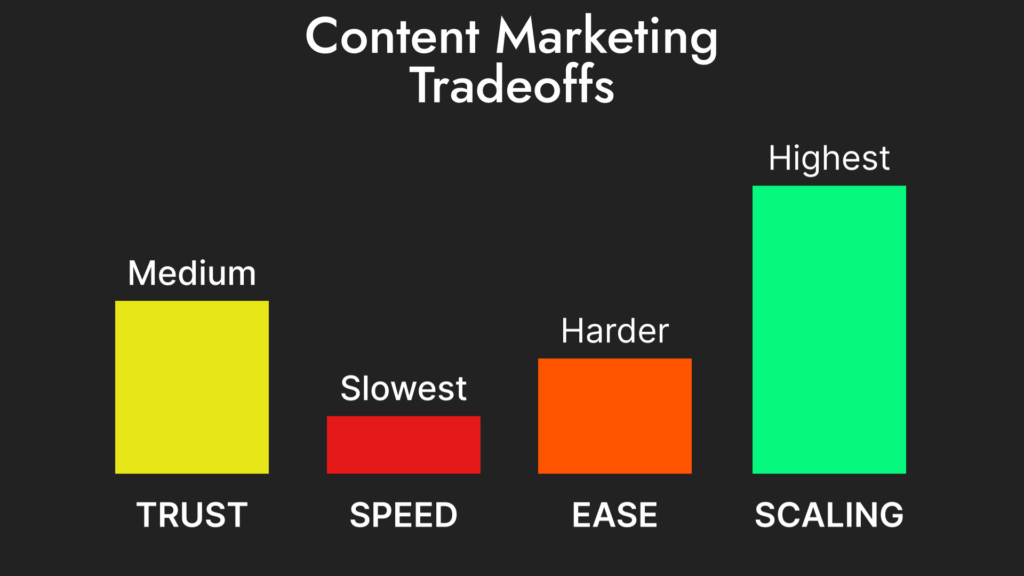
Here’s how content marketing stacks up:
- Trust: It’s about middle of the road for building trust at first, but it can grow very high over time. With enough content, people can binge your ideas and “test drive” what it would be like to work with you.
- Speed: It can be the slowest way to acquire your first client. If you’re committed and a little lucky, it can go faster, but platforms usually take a while to figure out who to show you to.
- Difficulty: It requires more upfront investment than other ways. Setting up a YouTube channel, recording a podcast, or writing articles takes time you could otherwise spend directly contacting people.
- Scalability: This is where it shines. Content marketing is the most scalable way to land clients; you can reach anyone in the world, including people you’d never meet through your personal network.
I’ve lived this. My first channel “Healthy Developer” started out small. But one video: “Why Do So Many Programmers Lose Hope” went viral and changed everything. But that didn’t happen instantly. There were years of showing up and learning how to speak directly to what developers were going through.
When I work with developers in the Technical Guide Offer Workshop, I encourage them to think of content marketing as a second-priority strategy once their premium offer is clear. Because then every piece of content can point to a very specific business outcome they help deliver, instead of vague generic dev tips.
Should I use speaking engagements to get consulting clients as a developer?
Talks at meetups, conferences, or private company events can be a powerful way to build trust quickly with a room full of potential clients. Especially if you enjoy teaching live. They’re harder to pull off and less scalable than online methods, but they can position you as a premium expert almost instantly in the eyes of the right audience.
This is where you give a presentation in front of a live audience to share your ideas. You’ve got an audience full of people who can’t just scroll away until your talk is over, and that can be really effective.
How do speaking engagements stack up?
Like everything else, there are tradeoffs:
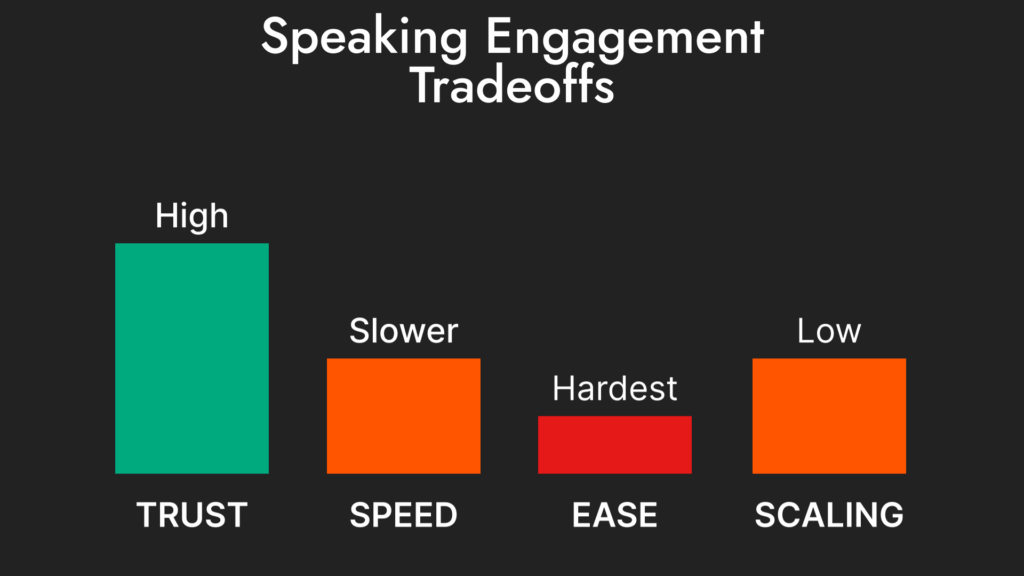
- Trust: Speaking puts you in a high-trust situation—almost as strong as networking—because people see you teaching, solving problems, and holding a room.
- Speed: The speed of acquiring clients is slower, because nothing really happens until the day of your talk. You might prep for weeks to have one shot with that group.
- Difficulty: It’s the hardest of the five ways to land clients. A lot of people fear public speaking more than death. If you’re one of them, this might be a deal-breaker.
- Scalability: It’s one of the less scalable options. There are only so many events you can speak at, especially if travel is involved.
You also have to be a strong communicator, finish on time, and inspire people enough that they want to come talk to you afterward instead of just heading to the hallway track.
If you love the stage and you’re already someone who naturally explains complex ideas to people, this path can work amazingly well for premium consulting offers—because buyers see you as an authority before you’ve even talked one-on-one.
In the Technical Guide Offer Workshop, we break down your offer into clear phases and outcomes, which makes it much easier to build a talk that isn’t just “here’s some tech trivia,” but “here’s the specific business problem I help companies solve and how.”
Can paid advertising help me land premium consulting clients?
Paid advertising is when you pay to put a message about what you can help with in front of people on platforms like YouTube, Facebook, LinkedIn, and others. The goal is to get them to book a call or join your email list.
Your advertising fee enables you to have a short video or audio clip shown to your potential clients. You can use the features of the advertising platform to narrow down who you show your message to by targeting specific demographics, geographies, and more. This tends to reduce your costs and is more effective.
How does advertising rank?
So how does it stack up on our four aspects?
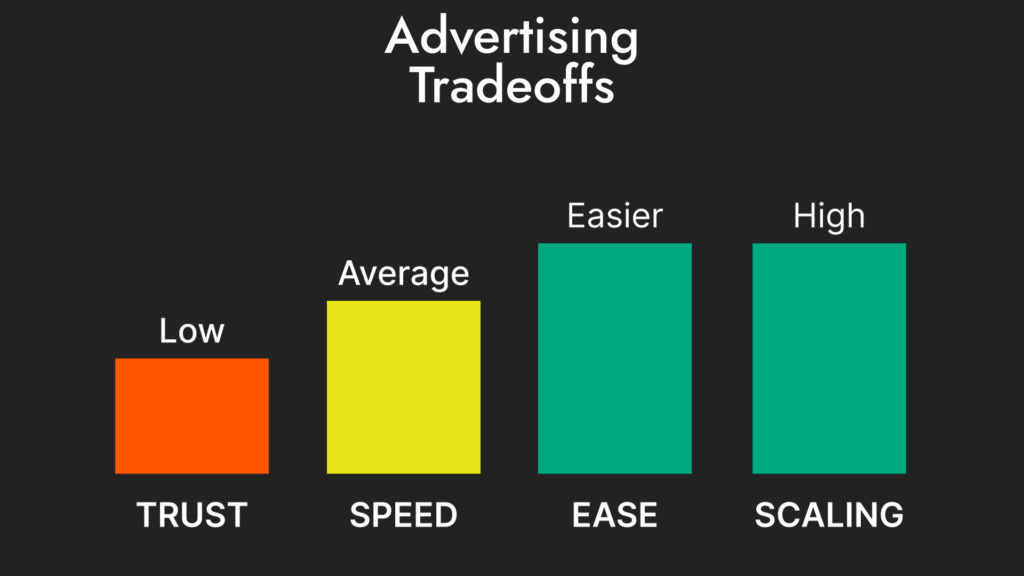
- Trust: Advertising is almost the lowest trust way of reaching a potential client. They don’t know you, and suddenly you’re popping up in front of them asking them to take some action. It’s a little better than cold outreach, but not by much.
- Speed: Ads are about average in terms of speed. You do have to put in some upfront effort to create your ad and set up the campaign, but once it’s running, you can get leads relatively quickly.
- Difficulty: It’s actually one of the easier ways to land clients mechanically, once you learn the basics. You need a good hook so they don’t skip or scroll, and you need to pack a compelling message into a short timeframe.
- Scalability: It’s one of the more scalable ways to land clients. Similar to content marketing, you’re limited mostly by two things: your budget and how many people are on the platform where you’re advertising.
If you’ve got money to burn, or you’re transitioning from a well-paying salary and can responsibly allocate part of it to testing ads, this can be a powerful accelerator. Just expect to make several ads that flop before you find one that works.
When your offer is designed the way we shape it in the Technical Guide Offer Workshop—tied to clear business value and premium pricing—it becomes much easier to justify the ad spend, because one client can pay for a whole lot of testing.
Which method is best for you to find premium consulting clients?
The “best” method to find consulting clients depends on your current network, your appetite for risk, how fast you need results, and what you’re naturally drawn to. In practice, most solo developers start with networking and/or cold outreach, then layer on content or speaking once their offer and positioning are validated.
Before I share some guidelines, there’s one more thing I want to point out.
You might’ve noticed I never mentioned referrals as a separate method. That’s because referrals can come from any of these strategies. A happy client from networking might refer you. Someone who watched your content might send a friend. A person who met you at a talk might pass you along internally.
Referrals are more of a result—a side effect of doing good work and staying visible—than a client acquisition strategy on their own.
So, which method is best for you?
If you’ve got a good network, start there
Ask people if they (or someone they know) have the problem your offer solves. It won’t be your long-term source of clients, but when you’re starting out, it’s more important to deliver your first version of your offer and learn than it is to build an enormous pipeline you’re not ready to serve yet.
This is exactly why, in the Technical Guide Offer Workshop, we obsess over translating your past work into business value. So you can talk to your network about outcomes, not just “extra coding on the side.”
If you want a client from a stranger as fast as possible
Use cold outreach.
You’ll be ignored by most people because you’ve built almost no trust. But your only real limit is your time. With a clear offer and a consistent prospecting habit, you can get in front of dozens or hundreds of potential buyers.
The premium offers we craft in the workshop are designed to make those conversations worthwhile—because when you’re targeting a $10k, $20k, or $30k engagement, a few good conversations can change your entire year.
If you don’t mind the camera and can be patient
Start a YouTube channel or commit to regular content on a platform like LinkedIn.
It may take longer, but once you get traction, you’ll have a constant flow of new prospects who show up already trusting you. That’s the core of how my own coaching business grew from my YouTube work.
What I see over and over in the Technical Guide Offer Workshop is that content becomes far easier to create once your offer is clear—because every piece can point back to a specific business problem and outcome.
If you’ve got budget to experiment
If you’ve got money to spend on learning, try advertising.
You’ll probably create a few ads that flop at first, but if you get one to work, scale usually stops being your problem. The constraint becomes how much time you actually have to deliver your offer.
Since we anchor pricing to business impact in the workshop, it’s normal for one client to cover the cost of quite a bit of experimentation—so if you’re in a financial position to do that, ads can pair well with a strong offer.
If you love speaking and live audiences
Try speaking engagements.
Few people genuinely enjoy (and are good at) moving a live audience. If that’s you, why wouldn’t you go for it? A strong talk plus a premium offer can open doors at conferences, user groups, and inside companies that need exactly what you do.
The same structure we build in the Technical Guide Offer Workshop. Business value, clear phases, and a premium, repeatable offer—becomes the backbone of a compelling talk that leads to real opportunities afterward.
Ready to own your tech career?
For most people, becoming an in-demand technical guide is a more realistic path to self-employment than building a SaaS.
That’s why I created the Technical Guide Offer Workshop.
In 4 evenings you’ll craft an offer to help companies getting ready to do something you already have, and is worth $300/hr every time you deliver it.
Build your offer live with me, Jayme Edwards—and other software professionals in a supportive, collaborative group.
Frequently asked questions
The best method to find your first consulting client depends on your strengths, your timeline, and your existing relationships. If you’ve got a solid network of former coworkers or managers, networking is usually the fastest and easiest way to land that first engagement. If you need clients from outside your network as quickly as possible, cold outreach lets you control your own destiny by directly contacting the right people, even though you’ll get ignored a lot. If you’re okay with a slower start in exchange for long-term scalability and authority, content marketing, speaking, or advertising can be powerful paths.
Underneath all of that, though, the real lever is your offer. A clear, outcome-focused consulting offer makes every one of these methods more effective, because you’re not just “a developer for hire”. You’re the person who solves a specific, painful business problem. In the Technical Guide Offer Workshop, I walk you through translating your experience into that kind of premium offer, so whichever client-finding method you pick has something compelling to point to.
If you’re introverted or allergic to traditional “sales,” you’re not disqualified from consulting. In fact, you may be better positioned than you think. Networking with people you already know tends to feel more natural, because it’s just honest conversations with former coworkers, bosses, or peers. Thoughtful cold outreach can work too, especially when it’s framed around genuinely helping with a specific problem instead of blasting generic sales pitches. Over time, content marketing (like writing articles or recording videos) can be a great fit for introverts, because it lets you share your thinking at scale without being “on” in real-time all day.
What makes all of these feel less salesy is clarity and alignment: knowing exactly who you help, what problem you solve, and what result you create, so conversations are about fit—not persuasion. In the Technical Guide Offer Workshop, I help you shape that kind of offer and messaging, so your outreach and networking feel like connecting the dots for people rather than pushing something on them.
You don’t need a perfect, final niche to start talking to people—but you do need more than “I write code.” At minimum, you want a directionally clear offer that connects your existing experience to a concrete business outcome: improving reliability, reducing risk, increasing revenue, streamlining operations, or enhancing user experience. That level of clarity makes it much easier to decide whether networking, cold outreach, content, speaking, or ads is the best channel for you right now, because you know who you’re trying to reach and what you’re offering them.
You can absolutely refine your niche and offer as you go, based on the conversations you’re having and the clients you land. The key is to start with a strong, testable version instead of a vague “developer for hire” message. In the Technical Guide Offer Workshop, I guide you through mapping your past projects to business value and turning that into a premium, repeatable consulting offer you can confidently take into any of the five client-finding methods I talked about.